Five Things I Tell Everyone Who's New to Claude Code
The 5 habits I give every new Claude Code user — context as a budget, goal-first prompts, iteration over perfection, build skills the moment you do something twice, and use /gitresearch to scout GitHub for upgrades.
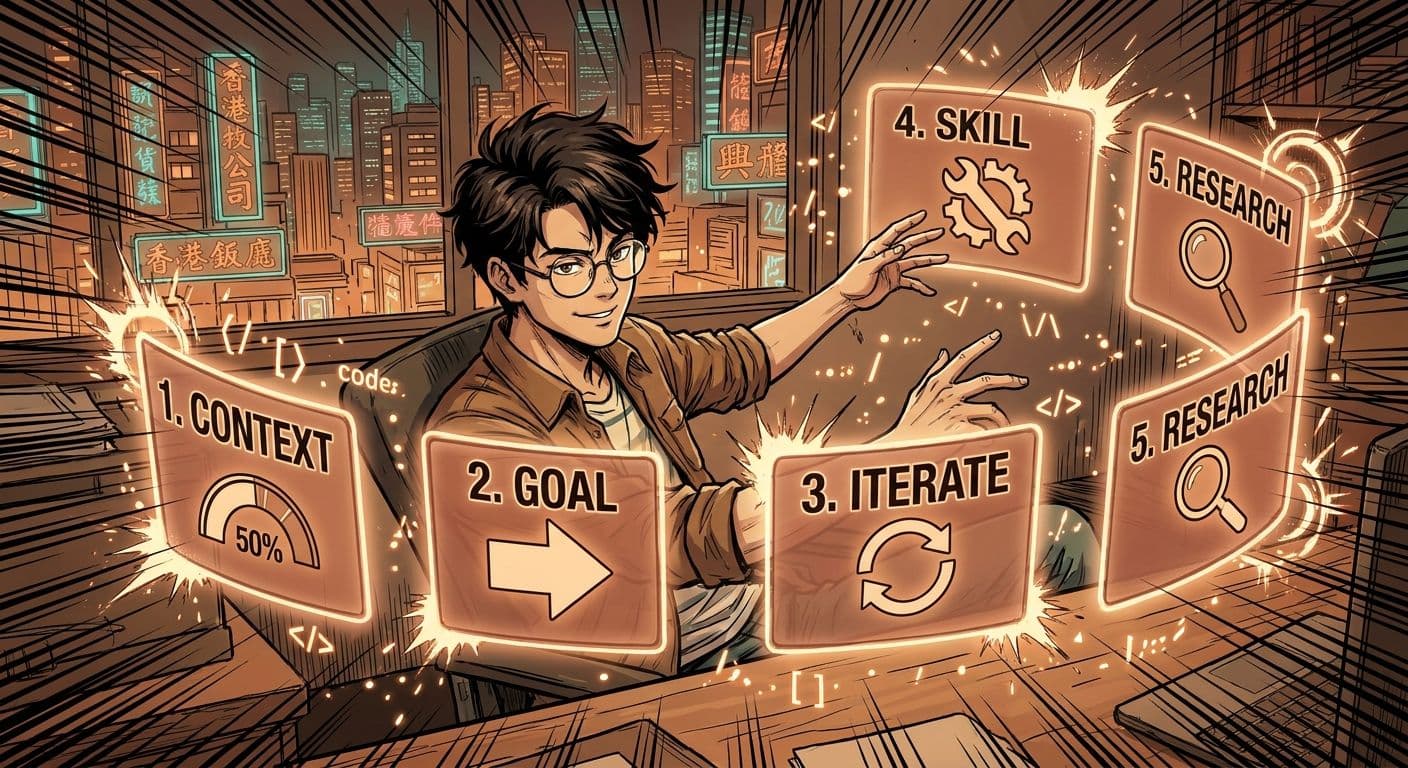
People keep asking what tips I'd give someone just starting with Claude Code. Here's the short version. Five habits. None of them are technical. All of them are things I wish I'd locked in on day one instead of day forty.
1. When the context bar hits 50%, stop and reset
Don't keep typing. Pick one of these:
/compact— squeezes the conversation, keeps the thread alive/session-wrap-upthen/clear— cleanly ends the session and starts a fresh one
Past 50%, two things start happening at the same time. Claude begins forgetting points you established earlier in the chat. And the responses get vaguer, because the model is paying attention to too many things at once.
I covered the workspace side of this in Post 5 and Post 10. The slash-command habit is the daily version of the same idea — context is a budget, not free.
2. State the goal first. Then the steps.
The single biggest difference between a useful prompt and a wasted one is whether you led with what you actually want.
Bad: "can you change the button color and also fix the spacing and maybe look at the form validation"
Good: "Goal: client-facing landing page that converts. Step 1: change the CTA button to terracotta. Step 2: tighten the form spacing. Step 3: add validation messages on the email field."
The goal anchors everything Claude does next. Without it, every step gets evaluated against "did the literal request happen" instead of "does this actually move the goal forward."
It feels like more typing. It saves you the second prompt where you say "no, that's not what I meant."
3. If you want to add something, just say so
Don't wait for the perfect prompt. Don't try to specify every detail upfront.
Type the rough idea. Read what Claude does. Then say "actually, also add X" or "make this part shorter" or "change the title to include Excel."
Claude is built to iterate. It will guide you toward what you didn't realise you wanted. The post I shipped earlier today — Small Tools, Big Brands, and My Excel — went through six rounds of edits before it hit the version I actually liked. None of those rounds were waste. Each one taught me what the post actually needed.
The rule: the first draft is a probe, not a deliverable.
4. Build a skill the moment you do something twice
Anything you find yourself typing twice is a skill candidate.
Examples from my own setup:
/burn— runs my weekly token audit/news— pulls the AI / tech briefing every morning/ghost— drafts blog posts from my session logs (this one wrote the first draft of the post you're reading)/session-wrap-up— captures handoff notes + key learnings every time I close a session
Building a skill is small. Use the create skill command (or skill-forge if you have it loaded). Tell Claude what you want the skill to do — what triggers it, what files it reads, what it produces. It writes the SKILL.md file for you. Next time you type the slash command, the workflow runs automatically.
The bar is "twice," not "I do this every day." Just twice. I covered the architecture of this in Hooks, Crons, and Skills — every skill turns a workflow into a one-line command you never have to re-derive.
5. GitHub is where the new ideas live. Use /gitresearch.
Most of the upgrades to my own setup didn't come from documentation. They came from random GitHub repos I tripped over on Twitter or in someone else's blog post.
The workflow:
- Find a repo that looks interesting
- Type
/gitresearchin Claude Code - Press Tab to autocomplete
- Paste the GitHub URL
- Let Claude read the repo, summarise it, and tell you what's worth stealing
Then you decide. Sometimes you adopt the whole tool. Sometimes you take one pattern and ignore the rest. Sometimes you skip it entirely because it doesn't fit your stack.
Earlier today I ran this on video-use — a video-editing CLI I'd never heard of. The first scan said skip. After I told Claude what I actually wanted to use it for (forking it for a bilingual editor), it flipped to "adopt." Now it's cloned, in a Python venv, symlinked into my skills folder.
None of that happens without /gitresearch doing the recon for me first. Reading a whole repo by hand is the work I no longer have to do.
That's it
Five habits. The same five I'd give you if you texted me right now.
You don't have to do them all on day one. But the day you start treating context as a budget, your prompts as iterations, and your repetitive workflows as skills — that's the day Claude Code goes from a chat box to a tool that actually saves you time.
What's the one habit you'd add to this list?
Enjoyed this post?
Get new guides and tools delivered to your inbox every week.